
I will be open about this: construction is an attractive market for ERP implementation. For me, the appeal starts with the work itself. Construction companies have interesting problems to solve: many interconnected processes, substantial contract values, significant revenue and costs, and plenty of opportunities to speed up work that is still handled on paper.
I have worked with construction companies extensively throughout my career. I developed project schedules using Microsoft Project, Oracle Primavera, and Spider Project, a scheduling system used in Russia and some other markets. The projects included complex multistory buildings, a nuclear power plant, roads, hospitals, and other facilities.
Whatever the project, the work came back to a familiar question: how much time and money will we need to complete it?
I also worked as an engineer within a construction company, responsible for calculating the economics of each project the company undertook. That experience has given me a practical, fairly specific view of how a construction business should operate.
So this is my personal perspective on construction ERP software: what a contractor needs at different stages, how those needs grow, and where I believe an ERP investment makes sense. I hope you find the experience useful, and I would be glad to hear where your experience differs.
What I Mean by Construction ERP Software
Let me start with a definition. Construction ERP is an enterprise resource planning system used by a company delivering construction services. You may also see the category described as construction industry ERP software.
My view is that construction has more in common with other operationally complex businesses than software marketing sometimes suggests. A contractor has customers, materials, equipment, suppliers, work in progress, completed work, and costs that must be assigned to the activity that generated them. A complex manufacturing business faces many of those same underlying questions.
Construction-specific detail matters: contracts, job costing, billing arrangements, project documentation, and required reporting all shape the implementation. I would start with those requirements and build on the ERP functions the company already needs across the business.
The practical question is which processes a standard platform can support, which need configuration or development, and which should remain in a specialist system. If you want the broader background first, our guide to Odoo for construction contractors looks at the construction context from the platform side.
Start with Operational Maturity
I find it useful to explain ERP requirements through levels of company maturity. I have watched small contractors grow and worked with large construction organizations. There is a great deal in common between them, but their processes cannot simply be identical.
A small company cannot reasonably carry every approval and reporting process of a large organization. A large business can put itself at risk if it continues to rely on the informal arrangements that worked when everyone sat in the same room.
Here is how I group those needs into three practical levels. Look at the complexity of your work as well as company size: a small specialist contractor may need demanding controls, while another company may operate comfortably at the second level for years.
Level 1: Customers, Quotes, Orders, and Getting the Work Done
At the beginning, a contractor choosing ERP should answer a few basic questions. How will we keep customer records? How will we track the jobs we are pursuing and the orders we have accepted? How will we know which work needs to happen, and when, so we can hand over the completed job?
Take an electrical contractor. It might receive inquiries through its website or invitations to bid. The customer arrives with requirements, an estimate or bill of quantities, drawings, or a scope of work. The contractor prepares a proposal, discusses the price, perhaps negotiates a discount, and agrees on the work.
The estimating method may be parametric, based on quantities and unit rates, or based largely on experience from comparable jobs. Either way, the commercial flow is familiar: understand the requirement, price the work, submit the quote, and follow through if the customer accepts.
At this level, I would start with contacts, CRM, quotations and sales orders, and a simple way to manage delivery. In Odoo, that can mean Contacts, CRM, Sales, and Project or Field Service, configured around how the contractor actually works. Field Service is particularly relevant when teams perform installations or service work at customer locations.
The interface examples below are from an Odoo demo environment.
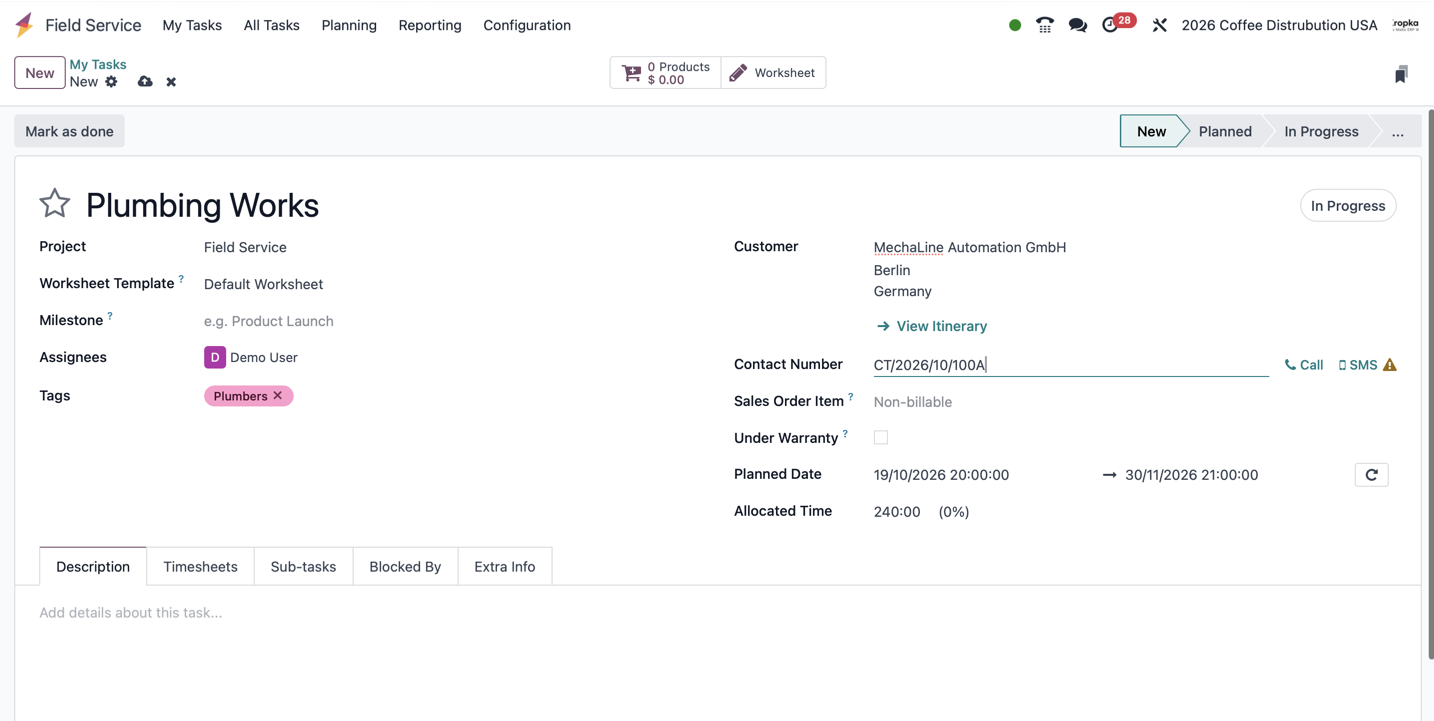
Invoice and payment visibility can be added here as well. Our guide to construction payment terms explains advances, progress payments, and certification time. The payment terms definition separates invoice due dates from the invoicing process. These determine when money is expected; they need to be considered separately from job profitability. In my experience, the immediate concern for many small contractors is cash: what should the customer pay, when should it arrive, and have we remembered to complete and bill the work? Good bookkeeping supports that everyday visibility.
Even this simple setup solves a surprising number of problems. Customers are less likely to be forgotten. The team can see what needs attention today and tomorrow. The owner can see the value of accepted work and expected receipts.
With rough cost assumptions, the company may also develop an initial view of expected earnings on a job. But sales value and cash received do not establish profit. If we want to understand what the job will actually earn, we need to go further into cost control.
Level 2: What Will We Buy, and What Will It Cost to Build?
As the company grows, the next question becomes: what are we prepared to spend to deliver the work we are bidding for? Tracking revenue matters, but it is only one side of the economics.
The company develops an estimated cost budget. Typically, this separates materials, purchased equipment, labor, construction equipment or rentals, and the overhead or other expenses management wants included in the project model.
In ERP terms, the business now needs purchasing, inventory and material tracking, material issues or consumption assigned to jobs, and a way to capture other project expenses. A purchase, a supplier, a receipt, an office expense, a business trip, or a fuel expense is a familiar ERP concept. The construction context changes how we organize and connect those records.
We agree on cost categories, responsibilities, and transaction rules, then connect these familiar ERP building blocks. For a contractor that previously managed them separately, that connection can be a major step forward.
An Installation Contractor Preparing a Bid
Consider a company installing electrical systems, fire alarms, fire suppression, or emergency notification systems. A promising invitation to bid arrives from a substantial customer. The opportunity is attractive, but we need to know what we can realistically charge and what delivery will cost.
The estimate includes installation work, materials, equipment, and overhead. If the customer has several remote offices, it also needs to reflect travel, repeat visits, accommodation, and the practical costs of supporting work across those locations.
That gives us an estimated cost and an expected project margin. Learning to calculate that expected margin consistently is already a meaningful management achievement.
Say we want to retain a 35% margin on a job. We need to define the calculation clearly: margin is profit divided by the selling price, while markup is profit divided by cost. Agree which costs are included, then use the same basis when comparing the estimate with results.
Execution then needs to connect to the estimate. The buyer places orders with suppliers; materials are received and issued to jobs; equipment and employee expenses are recorded. Purchase, Inventory, Expenses, and Accounting can contribute to this workflow, alongside the relevant project records.
The objective is to compare the planned economics with what the company is buying and consuming. For a useful project-level profit and loss view, we assign costs and revenue to the right job consistently.
A Practical Example from My Work: Preparing and Delivering a Bid
Let me show you what this second level looked like in a company I worked with. It was a small construction business, but the opportunities it pursued involved substantial contract values. Let me walk you through how we prepared a bid and carried its cost assumptions into delivery.
Coordinate the Bid Package
The company receives an invitation to bid. The project manager responsible for preparing the opportunity creates and coordinates tasks in CRM: which department needs to collect which documents, and what must be ready for the submission?
The package may include technical documents, certificates, company financial statements, and references or records from previous projects. The invitation sets the document requirements. The team needs to demonstrate its technical capability and company qualifications alongside the price.
Connect the Customer Proposal to the Internal Estimate
The key financial document combines the proposed contract value with the estimated cost of delivering it. In structured form, it shows the scope items, work, materials, and equipment that will be offered to the customer, together with the costs the contractor expects to incur for those items.
What matters is that the customer-facing and internal structures are connected. We can see what a particular scope item will sell for and what internal rate or cost assumption supports it. The customer sees the commercial proposal; the team keeps the linked internal cost breakdown for its own review.
The next question is always: where did the project manager get that cost?
For each important type of work, the supporting detail explains the calculation. How much labor is required? Which labor rates and applicable payroll-related costs are included? What material quantities and forecast prices are assumed? What equipment or subcontracted work will we need?
Where current supplier pricing is available, we use it. The purchasing team sends requests for quotation, or RFQs, through Purchase and collects supplier responses. A supplier quote supports a forecast cost; it is different from the supplier bill that arrives for an actual purchase.
We also consult records from earlier jobs. Historical supplier bills and project information help explain what similar work cost previously and why. We compare those earlier prices and productivity assumptions with the conditions of the new job.
Step by step, the team builds a supporting record. The project manager can explain how much money delivery will require, which additional expenses have been included, and what the company expects to earn.
Review the Economics and the Delivery Sequence
The project manager presents the proposed job to management: this is the quantity of work, these are the rates we intend to offer the customer, this is what the company expects to spend, and this is why.
For the most important items, the discussion includes supplier quotations and relevant historical purchasing records. The team challenges the realism of the assumptions, considers risks, and includes appropriate allowances or contingency for uncertainty.
Travel and accommodation deserve particular attention when crews will spend time away from their normal base. An attractive contract price can look quite different once repeated trips and a longer stay on site are included.
In some cases, we also develop a preliminary project schedule, especially when the bid requires delivery within a tight timeframe. It explains how much time we intend to allow and in what sequence the work can be performed.
Where specialist equipment takes several months to arrive, procurement lead time belongs in the schedule. Otherwise, the installation plan may look workable while ignoring the item that determines when work can actually start. The sequence of dependencies helps explain the overall project duration.
Keep the Information in One Working Environment
In the workflow we used, Sales supported the quotation to the customer. Documents held the project manager’s calculations and supporting files. Purchase held RFQs and supplier quotations. Earlier supplier bills and job records provided historical evidence within Odoo.
We could also prepare a preliminary Gantt schedule in Odoo to show the intended sequence of activities. For more demanding dependency and resource planning, I would assess the scheduling requirements separately and connect a specialist tool where it adds value.
The useful part was that the team could conduct the review in one working environment. The estimate, its supporting documents, supplier pricing, and relevant project records were connected rather than scattered across personal inboxes and unrelated spreadsheets.
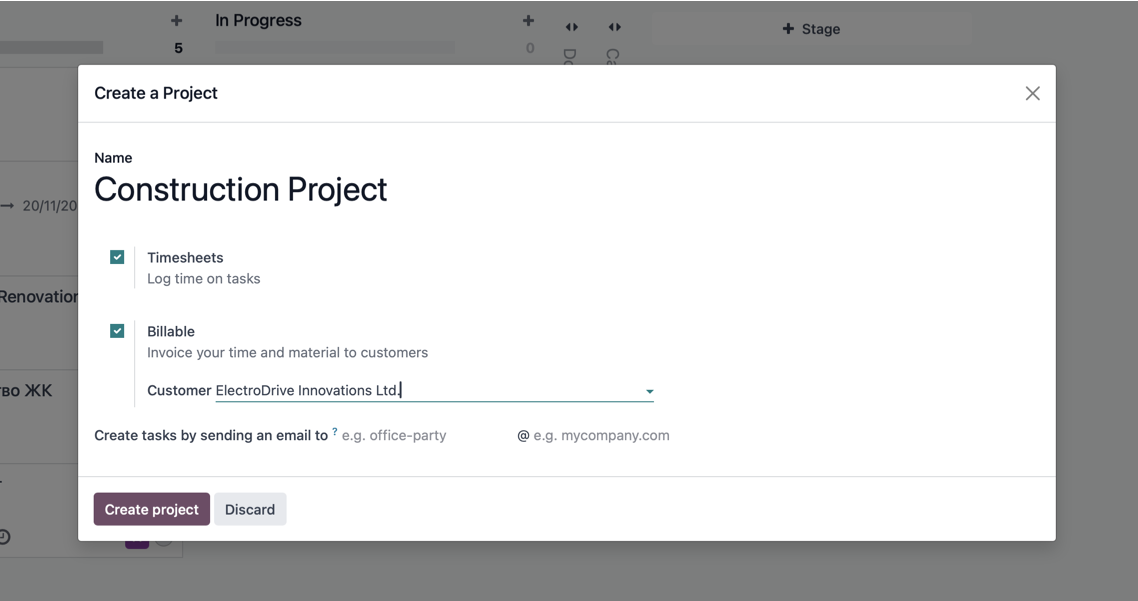
Use the Same Estimate Once Work Starts
After the contract is awarded, the logic continues. The project manager organizes work from the agreed schedule, places orders, and coordinates supplier commitments.
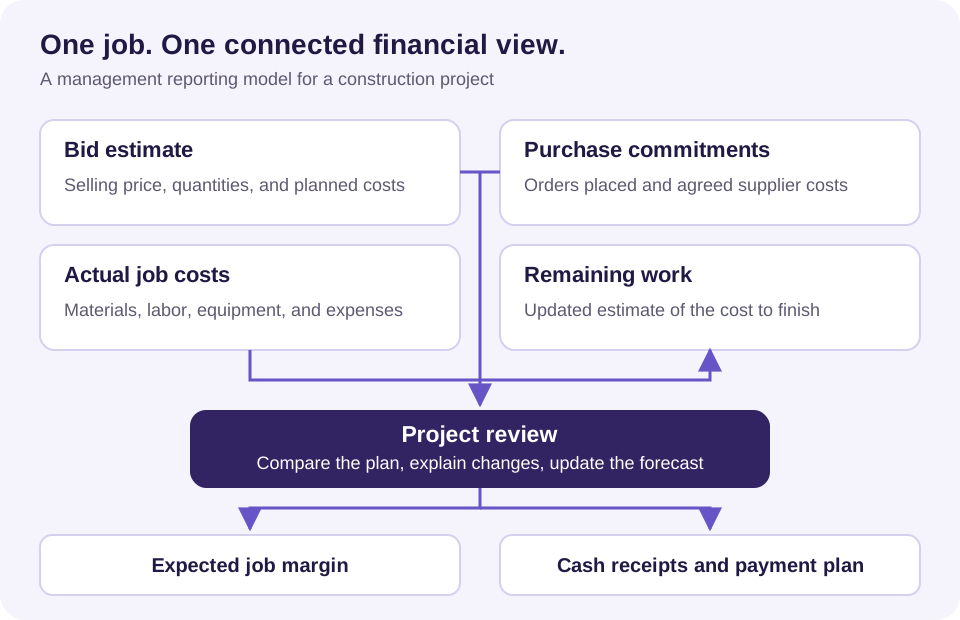
Supplier bills and payments are recorded and checked against the planned job economics: the quantities, rates, and forecast totals discussed when the bid was prepared. A purchase commitment should also be visible before it becomes a bill, so the team does not discover a cost increase only after the money is already committed.
An exception may be justified. The scope may have changed, a supplier price may have increased, or an assumption may need correction. The important point is that the difference is visible and someone can explain it.
This is what I mean by making a small contractor’s work more transparent and reliable. You can challenge a purchase that does not match the estimate, anticipate the resources the job needs, and make a better-informed decision about whether a bid is worth pursuing. These are fairly simple management actions, but they can be very valuable.
For me, this is the real benefit: the team can use the same financial logic when deciding whether to bid, placing orders, and reviewing the job during delivery.
Where Scheduling and Construction Project Management Fit
I want to pause on scheduling, because it can sound surprising coming from someone who has spent so much time building construction schedules.
My view is that a sophisticated schedule is not always the first thing a small contractor needs. Many repeatable jobs turn over quickly. Management may be focused on completing the work within the expected cost and retaining the agreed margin.
Those projects might last a month or two, perhaps three or four. They still need dates, assignments, coordination, and attention to important deliveries. But they do not automatically require the full planning machinery of a major construction program.
Duration is only one consideration. A short job can have critical dependencies, and a long equipment lead time can make scheduling essential even for a small business. I would choose the depth of planning based on those realities.
When I talk about project management at the next level, I mean comprehensive project controls: multiple connected subsystems, shared resources, detailed cost allocation, budgets, and management reviews. Small contractors already manage projects; they may simply not need that entire control structure yet.
This also helps explain the difference between construction ERP software and construction management software. A project tool may organize delivery very well. The ERP layer connects that work to purchasing, inventory, company finances, and other business records. Product boundaries overlap, so evaluate the actual workflow rather than relying on the category label.
For related perspectives, see our guides to Odoo project management for construction, choosing construction management software, and construction management and predictable project delivery.
If you are comparing a connected ERP with a standalone task tool or specialist scheduler, my guide to choosing project management software explains how I make that decision.
Level 3: Comprehensive Project and Financial Controls
The next level involves a more complete view of the project and its relationship to the rest of the company. This is where the number of connected processes and the discipline required to maintain them increase substantially.
Allocate Labor and Shared Expenses to Jobs
One sign of this level is the systematic allocation of payroll and labor costs across projects. Direct field labor may be relatively easy to assign when people work on one job. Engineering, supervision, and other shared personnel can be more difficult because their work spans several sites or projects.
The company records effort, captures expenses, and applies an agreed allocation method. The goal is to understand which jobs consumed those resources, rather than leaving everything in a company-wide overhead total.
Analytic accounting supports this management view. A shared expense can be distributed across several projects in defined proportions. We set up the project dimensions and allocation rules so that the distribution follows the way the company actually uses those resources.
I associate consistent shared-cost allocation with greater process maturity. A small contractor may reach this point early when shared engineering or management effort has a significant effect on job profitability.
Move from an Estimate to Ongoing Budget Control
At this stage, cost budgeting becomes an ongoing management process. It resembles the initial estimate, but now the company reviews it regularly, often monthly, and compares the original assumptions with current budgets submitted for approval.
I would keep the original estimate, the approved budget, and the current forecast distinct. The estimate records the assumptions used to price the work. The budget establishes the authorized plan. The forecast reflects what we now expect to happen.
The company may also plan revenue, billing, and customer collections. These need separate treatment: work performed, revenue recognized, invoices issued, and cash received are not necessarily the same event. Our explanation of cash flow versus profit explores that distinction.
Project-level plans can then be consolidated into a company view. Management can consider which projects need resources next month, what spending is expected, and whether anticipated customer receipts will support those commitments.
Connect Cash Planning and Payment Requests
That brings us to treasury management, cash budgets, and payment requests. In a small owner-led company, approval may be a quick conversation. As the number of projects, departments, and payments grows, that informal model becomes much harder to sustain.
At ERPixel, we developed payment-request functionality some time ago, use it ourselves, and implement it for clients. It is particularly useful when a company wants payment decisions to follow an approved cash budget.
The employee initiating a payment submits a request and supporting documents. In the workflow we developed, AI can assist with recognizing information in those documents, while configured rules determine the approval route.
Different people or departments then review the request, sequentially or in parallel, and record their decisions. At the end of the approval process, finance can check the request against the budget: is it planned, is it an exception, and what effect will it have on the available funds?
The result may be execution within budget, an explicitly approved exception, or a decision to defer the payment. Approval and actual payment should remain separate recorded steps. For more on the planning side, see cash flow budgeting in Odoo.
Maintain Connected Contract Records
Another feature of this level is systematic contract management. Customer contracts, supplier agreements, subcontracts, equipment purchases, and equipment rental arrangements need to connect to the relevant job and financial records.
Contracts exist at earlier levels too. The difference I am describing is consistent follow-through: the agreement, scope, changes, commitments, bills, and payments remain connected throughout delivery.
For a US contractor, that evaluation may include change orders, progress billing, retainage, and subcontractor documentation where the contracts require them. Bring examples of those documents and transactions to the software demonstration and ask the team to walk through them. Our article on contract variations and changes in construction provides related context.
Reporting: Check the Requirement Before Choosing the Solution
Required reports and documents are a major consideration in any ERP implementation. A platform designed for many industries will not automatically include every form a particular construction company needs.
My view is that adapting a defined report can be more practical than buying a much more expensive system solely because it already contains that form. ERP development tools can make focused reporting work accessible, and I would encourage a company to bring its actual forms into the discussion.
A straightforward form can be a quick development task when the necessary data is already available. If it needs new calculations or additional records, we include that work in the scope.
Bring us the reports you use. We can review the format, source data, calculations, and applicable requirements, then agree on the work and how the result will be checked.
Where I See Odoo Fitting into Construction ERP
I see Odoo as a strong platform for managing a construction organization because it offers an interconnected suite of applications across commercial work, operations, and finance.
Rather than choose by module count, I would look at the connections you need: Contacts and CRM, Sales, Project or Field Service, Purchase, Inventory, Documents, Expenses, time tracking, and Accounting. More mature requirements may add payroll integration, budgeting, payment approvals, and contract-related development.
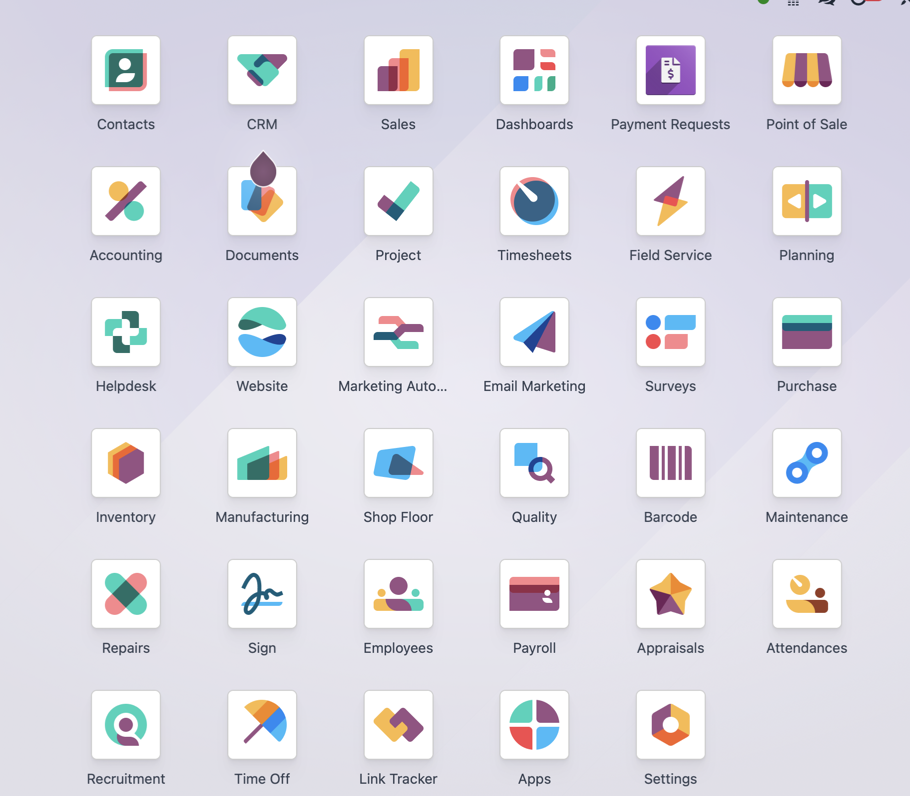
Accounting provides the financial foundation. We configure company records, analytic dimensions, and transactions to support reporting by job, work type, legal entity, or other useful business dimensions. For organizations working across countries, we also define the local and consolidated reporting needs.
In our practice, we have built integrations that bring in information from estimating and quantity-calculation systems, send data to external applications, and connect ERP with electronic delivery-document systems, supplier systems, 3PL providers, and warehouse operators.
The relevant integrations vary by contractor. The point is to preserve useful specialist tools while connecting the information that management needs. Microsoft Project and Oracle Primavera can remain part of that environment; we also have experience with those tools.
For the platform details, explore Odoo Project, Odoo Purchase, Odoo Inventory, and Odoo Accounting. Our Odoo integration services describe the work involved in connecting systems.
A Practical Table for Choosing Your ERP Scope
Here is how I would use these three levels when talking to an ERP vendor or implementation team. Find the situation closest to yours, then ask them to demonstrate it with one of your own jobs.
| Your situation | What I would connect first | What to ask the team to demonstrate |
|---|---|---|
| Level 1: Quotes, customers, and work are hard to track | Contacts, CRM, quotations, accepted orders, job assignments, dates, invoices, and payment status. | Take an inquiry through a quote and accepted order. Assign the work to a crew, show tomorrow’s jobs, and identify what still needs to be invoiced or collected. |
| Level 2: You need to defend the bid price and protect the expected margin | The estimate, supplier RFQs, purchasing, material receipts and job consumption, labor, equipment, expenses, and job accounting. | Trace one proposal item to its cost calculation and supplier quote. Place the order, record the material and expense, and compare estimated, committed, and actual costs for that job. |
| Level 3: Several projects compete for people and cash | Shared labor and overhead allocation, approved budgets, forecasts, contract changes, cash planning, and payment approvals. | Allocate a shared engineering cost across jobs. Review a budget change, route a payment request, and show its effect on next month’s cash plan and expected job result. |
| Your delivery depends on several trades, shared resources, or long-lead equipment | The project schedule, purchasing milestones, activity dependencies, and the relevant specialist scheduling tool. | Move an equipment delivery date and explain which activities and completion dates are affected. Show how the revised plan reaches purchasing and the project manager. |
| Your contracts or reporting have specific requirements | The required contract records, change orders, billing documents, report inputs, and integrations. | Use a representative contract and report. Walk through the calculation, approval, and output, and identify which parts use standard functionality, configuration, integration, or development. |
The last two rows can apply at any level. My advice is to choose the smallest coherent scope that answers your current business questions and gives the next stage a solid foundation.
My Advice: Follow One Real Job Through the Proposed System
If you are choosing construction ERP software, I would start with a representative job from your own business. Follow it from the customer inquiry through the estimate, quote, purchasing, materials, work execution, supplier bills, customer invoices, and payments.
At each step, ask what the next person needs to know and whether the information remains connected. Can the project manager explain a cost? Can the buyer see the agreed allowance? Can finance relate a payment to the job and its budget? Can management understand the expected result before the project ends?
A small contractor may need contacts, CRM, orders, and a reliable delivery workflow first. A more developed operation may need planned-versus-actual job costing, purchasing, material consumption, and employee expenses. A company with more complex controls may need shared-cost allocation, ongoing budgets, cash planning, approvals, and systematic contract management.
These are different starting points for the same underlying question: when we win and deliver construction work, how much time and money will it take, and what will we earn?
If you would like help working through that question, we would be glad to talk. ERPixel can help with Odoo consulting, implementation, integrations, data migration, and team training. You can contact us or book a conversation to discuss your current process.
And I am interested in your perspective, too. At what point did your company outgrow its previous tools? Was the first real problem scheduling, purchasing, job costs, or cash? The answer often says more about the right ERP starting point than a software comparison table does.