
Odoo key users and process owners
Business participants evaluating where AI can improve an Odoo-centered workflow.
Business and technical · Odoo AI training
Learn how to turn Odoo data, business processes, workflow automation and AI into controlled, useful operational workflows.
Practical workflows · Guided discussion · Skills for real Odoo use
Course overview
This mixed business and technical course goes beyond a tour of built-in Odoo AI features. Participants learn to identify useful AI opportunities, distinguish deterministic automation from AI, use Odoo records as controlled context, design external LLM and orchestration workflows, apply human approval, and move from a prototype to supportable production use.
Who should attend
The course is focused on roles that use, supervise or support the covered Odoo processes.
Business participants evaluating where AI can improve an Odoo-centered workflow.
Teams translating business requirements into native, automated or AI-assisted solutions.
Technical participants responsible for APIs, orchestration, controls and ongoing support.
Prerequisites
Required and recommended knowledge is stated clearly so participants can choose the appropriate level.
Participants should understand the Odoo-centered processes they want to improve.
Familiarity with relevant records and applications helps ground the use cases.
API, n8n or development knowledge is useful but not required for business participants; a technical hands-on scope can be arranged separately.
What you will learn
Learning outcomes connect system actions with the business process and the result users need to understand.
Distinguish valuable extraction, classification, summarization and generation tasks from poor-fit or deterministic work.
Compare relevant built-in Odoo capabilities with external AI and custom integration.
Choose the minimum useful Odoo records and respect permissions and data boundaries.
Define inputs, outputs, validation, human review, retries and exception paths.
Connect bounded agent actions with Odoo APIs, workflow tools and approval gates.
Evaluate privacy, hallucination, reliability, cost, monitoring and maintenance before deployment.
Course program
Modules progress from the necessary records and concepts into connected operational scenarios.
Classification, extraction, summarization, generation and decision support; deterministic vs AI automation; use-case selection.
Relevant native capabilities in the target version, their limits, and when external AI is justified.
Business records; minimum useful context; permissions; access boundaries and unnecessary data exposure.
Extraction, summarization, drafting, classification and conversion of unstructured information into Odoo-ready data.
Request classification, context summaries, draft communication, research and assistance with human review.
Odoo and LLM APIs; structured context and responses; retries; errors; write-back; synchronous and asynchronous choices.
Triggers, branching, validation, approvals, logging, exceptions and maintainable cross-system workflows.
Tools and actions; Odoo as context and action system; permissions; approval gates; bounded autonomy and auditability.
Hallucination, data quality, confidentiality, output validation, human review, cost, monitoring and maintenance.
Outcome and data definition; native vs external choice; prototype; validation; controls; deployment; monitoring and improvement.
Practical business scenarios
The training goes beyond a feature tour by connecting actions across records, roles and business outcomes.
Extract structured fields, validate them, prepare an Odoo record and require human approval.
Classify an incoming request, validate the result and route it without granting uncontrolled business actions.
Assemble permitted Odoo context and produce a reviewed summary or draft communication.
Define a bounded task, allowed tools, approval gates, audit trail and exception path.
Evaluate an AI demo for data quality, reliability, privacy, cost, monitoring and ownership.
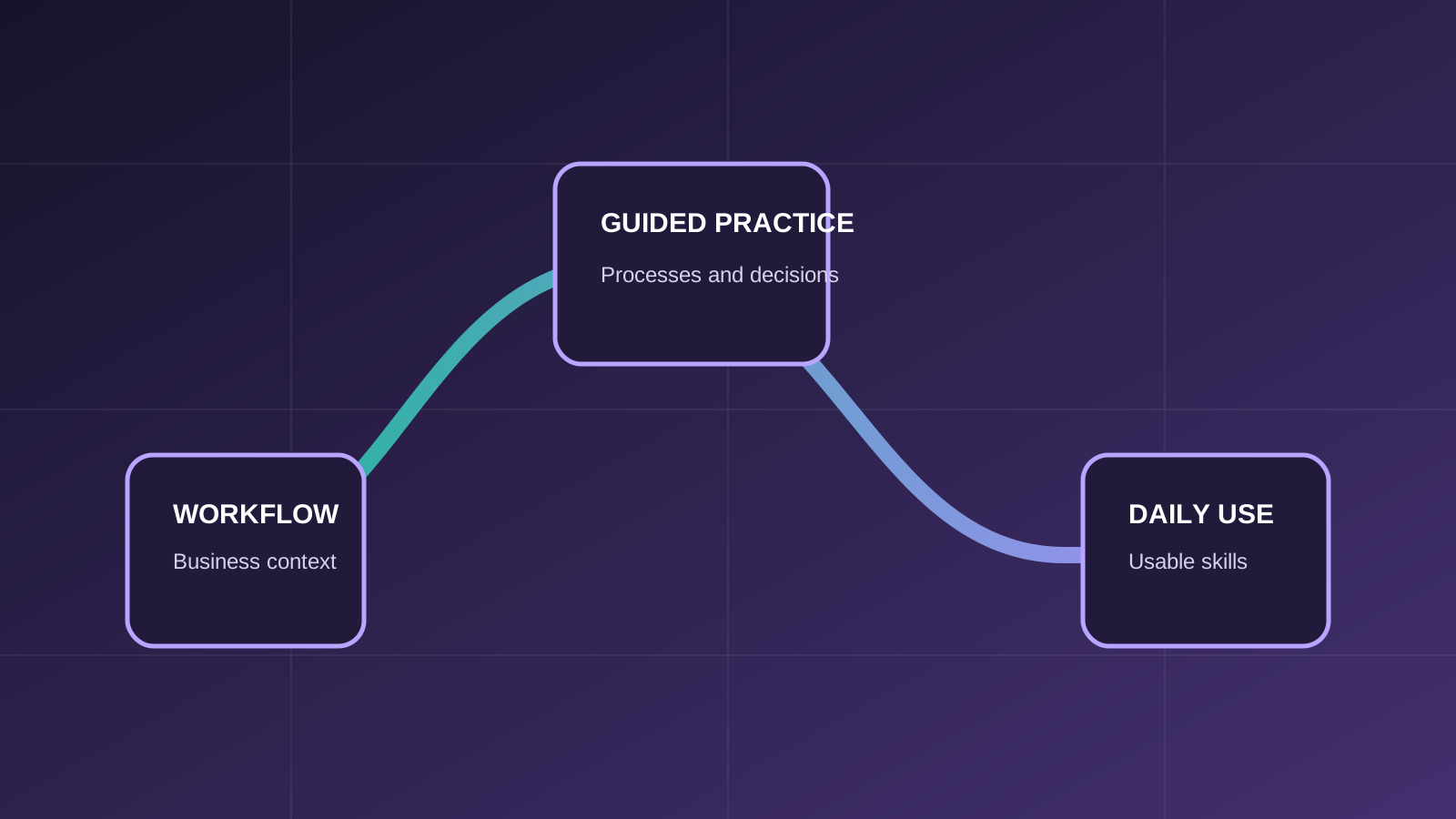
Training approach
ERPixel connects Odoo actions to the business decisions, records and handoffs behind them.
Each feature is explained in the context of the business workflow it supports.
Participants work through the records, decisions and exceptions used in day-to-day operations.
The course creates room to clarify why a workflow behaves as it does and how connected Odoo apps affect it.
Learning outcomes focus on tasks participants should be able to perform and interpret after training.
Official Odoo Partner
Odoo implementation, development, integration and ongoing support.
Why train with ERPixel
ERPixel connects functional instruction with the implementation, integration and support context in which Odoo users actually work.
The trainer brings more than a decade of relevant experience across business software, ERP, Odoo, analytics and automation work.
Training explains how records, controls and connected Odoo apps support the wider operating process.
As an official Odoo Partner, ERPixel understands how configuration, user responsibilities and adoption meet during delivery and ongoing use.
Related learning and expertise
Explore an adjacent course, application or ERPixel service.
Explore ERPixel implementation services for controlled AI-enabled workflows.
See the API and cross-system foundation behind Odoo-centered AI workflows.
Build the technical Odoo foundation for custom integrations and maintainable automation.
Course FAQ
Clarify the expected experience, scope and relationship to other ERPixel courses.
No. Native capabilities are one module. The wider course covers use-case selection, Odoo context, external AI services, APIs, orchestration, agents, human review and production controls.
No. The functional course does not require ML or data-science knowledge. Technical API and orchestration experience is useful for hands-on integration sections.
No. It focuses on bounded workflows, permissions, structured outputs, human approval, auditability and operational controls.
Yes. Scope can be aligned with participant roles, Odoo applications, process examples and technical depth after an assessment.
Odoo training for your team
Tell us about the participant roles, current Odoo experience and workflows you want the training to address. We can clarify course fit and the appropriate scope.