
Cash flow management means planning when money will arrive and leave, authorizing payments, and comparing execution with the approved plan. In ERPixel implementations, we typically use quarterly cash budgets with monthly breakdowns, cost-center ownership, forecast exchange rates, and actual bank transactions. This connects a cash flow strategy with the decisions finance makes every day.
In my experience, a useful budget answers three questions: What did we approve? What have we paid? What do we now expect to pay by the end of the period? I estimate that we implement budgeting for roughly every second ERPixel client. This is my observation from our work, rather than an audited client statistic.
This guide combines practical cash flow strategies with an anonymized implementation for a group operating in seven jurisdictions. It explains the management process; our separate Odoo Cash Flow Budgeting guide describes the solution itself.
About the illustrations. Due to NDA obligations, we cannot disclose real client figures or data. All companies, figures and records in these illustrations are fictional. These redrawn interface mockups reflect the essence of our approach, not exact client screenshots.
Our experience: a group operating in seven jurisdictions
One group we worked with operated in seven jurisdictions with a complex accounting structure. Revenue arose in different parts of the business and involved complex recognition arrangements. Some departments incurred costs that other departments paid. Finance needed to understand which project and cost center a payment belonged to, and where additional funding was becoming necessary.
Payments involved numerous local currencies, while management consolidated budgets in US dollars. The group needed one view of planned payments without losing the underlying currencies or responsibility for each budget.
Before implementation: separate Google Sheets for each company
Finance maintained spreadsheets by company, separated cost centers, and used formulas and cross-sheet links to calculate totals. Collecting payment requests and assembling the quarterly plan required repeatedly entering, checking, and reconciling large amounts of information.
After implementation: reusable budgets and consolidated visibility
We introduced budget documents in Odoo with periods, budget currencies, cost centers, and payment lines. Finance could consolidate future budgets into a group planning view and copy existing budgets into the next period, update forecast rates, and remove one-off items.
Which manual work we removed from repeated budget preparation
The change was concrete: recurring budgets could be copied, forecast rates updated, and one-off requests removed. Finance no longer had to repeat the same spreadsheet preparation and cross-file calculations for every new quarter.
| Previously repeated work | What replaced it | What finance still reviews |
|---|---|---|
| Populate the next quarter’s spreadsheets with recurring budget items. | Duplicate existing budgets rather than enter the recurring plan again. | Remove one-off items and check amounts, suppliers, and payment dates. |
| Combine company and cost-center totals using formulas and cross-sheet links. | Consolidate the future budgets held in Odoo into one planning view. | Check that the relevant company and cost-center budgets are included. |
| Use spreadsheet calculations to express amounts across currencies in a common total. | Use the budget currency and its exchange-rate table for the calculations. | Set and review forecast rates; actual payments use payment-date rates. |
| Collect payment-request information through the spreadsheet-based preparation process. | A payment-request document identifies the supplier, invoice, amount, currency, and budget, then follows the category’s approval route. | Provide the supporting information, review the request, and execute approved payments. |
After a bank transaction is assigned to the relevant budget, the system calculates the corresponding actuals and budget comparison automatically. Finance remains responsible for the assignment and for explaining deviations.
My estimate is that copying and adapting recurring budgets can save more than 60% of the repeated budget-preparation work in this context. This is a practitioner estimate about that preparation activity, not a measured saving across the entire finance function or a guaranteed result for another company.
Copying still requires review: remove non-recurring items and check suppliers, amounts, payment dates, tax assumptions, and forecast rates. Reusing last quarter’s errors simply makes them recur faster.
When this approach is useful
This approach is particularly relevant when finance needs to connect several companies, currencies, and budget owners in one planning process. The following situations reflect the problems in the group implementation described above.
- Each legal entity maintains a separate spreadsheet. Group planning depends on formulas and links between files.
- Departments incur costs that other departments pay. Finance needs to identify the project and cost center responsible for the payment, alongside the company executing it.
- Payments use several currencies, but management needs one planning currency. Local-currency payments must be understood within a consolidated USD budget view.
- Quarterly preparation repeats much of the previous period’s work. Recurring items need to carry forward while one-off items and forecast exchange rates are reviewed.
- Payment categories need different approval routes. Marketing, IT, and payroll can follow separate approval templates.
- Management needs to see overruns against the approved plan. Actual payments and remaining planned payments need to support a current forecast without silently replacing the original budget.
My view: the need becomes clear when finance spends each quarter assembling the numbers across files while still needing to establish whose budget is being executed and where extra money is required. Those were practical problems in this group, and they shaped the workflow we implemented.
What is a cash flow management strategy?
A cash flow management strategy sets out how a company forecasts cash, collects receipts, schedules payments, maintains liquidity, and responds to deviations. It needs responsibilities and review dates, as well as financial reports.
A profitable company can still face a shortage of cash when customer receipts arrive after supplier, salary, or tax payments fall due. For the underlying distinction, read why cash flow is different from profit.
| Term | Practical meaning |
|---|---|
| Cash flow budget | Planned cash receipts and payments over a defined period. |
| Approved budget | The version of the plan authorized by the company. |
| Current forecast | The latest expectation of cash movements, incorporating actual execution and remaining expectations. |
| Accrual budget | Revenue and expense planning based on recognition periods, which may differ from payment dates. |
| Cost center | An area of budget responsibility, such as a department or another defined business unit. |
| Gross payment | The full cash amount paid, including VAT where it forms part of that payment. |
| Payment request | An internal document requesting authorization to pay a supplier or another recipient. |
| Actuals and variance | Recorded cash movements, and their differences from planned amounts. See budget variance. |
Nine cash flow strategies to connect with your operating process
The following strategies work together. The appropriate terms, reserves, and financing arrangements depend on the company’s obligations and risk profile. They should become explicit assumptions in the cash plan.
1. Maintain a dated forecast and review it regularly
Start with available cash, expected receipts, and planned payments. Use expected collection dates as well as contractual due dates. Set a review cadence appropriate to volatility; a monthly breakdown may need a weekly or daily view around a tight payment period.
For a simple period calculation, projected closing cash equals opening available cash plus expected receipts minus expected payments. Check the lowest point within the period too: a positive month-end balance can hide a mid-month shortfall.
2. Align customer collection and supplier payment schedules
Compare when customers are realistically expected to pay with when suppliers must be paid. Negotiate changes where needed and reflect agreed dates in the forecast. Do not assume that a customer’s 30-day payment term will fund a supplier payment due after 15 days.
For groups, review availability by legal entity and currency. A positive consolidated balance does not mean cash can immediately be used by every company. Internal funding must respect the applicable legal and financial arrangements.
3. Improve collection before offering blanket discounts
Issue accurate invoices promptly, agree payment terms, and follow up on overdue balances. Consider deposits or milestone payments where they fit the contract. An early-payment discount has a margin cost: compare that cost with the benefit of earlier collection before offering it.
Odoo Invoicing and accounts receivable provide related billing and collection context. Australia's government guidance also explains clear customer payment terms.
4. Include inventory decisions in the cash plan
Stock purchases and supplier advances consume cash before the related sale generates a receipt. Review slow-moving stock, replenishment quantities, and delivery lead times alongside purchasing plans. The objective is to avoid unnecessary cash tied up in stock while preserving service and production needs.
Use the cash conversion cycle to understand the relationship between inventory, receivables, and payables. Our Odoo Inventory overview explains the operational side.
5. Give budgets owners and include gross cash obligations
Assign responsibility by cost center. Include the full amounts expected to leave the bank, including applicable VAT and advances. Distinguish recurring payments from one-off items, and specify dates for obligations such as payroll.
6. Assess contingency funding before a shortfall occurs
If the forecast exposes a temporary gap, assess available funding with the company’s finance advisers and lenders before it becomes urgent. A credit line is one possible tool, subject to eligibility, cost, currency, covenants, and availability. Include any expected drawdown, interest, and repayment in the plan.
7. Test delays and maintain a deliberate liquidity buffer
Model a delayed major receipt, a currency movement, or an unexpected payment. Decide which payments are essential, who can approve changes, and what minimum available cash the business needs. Set that buffer from the company’s circumstances rather than a universal percentage.
8. Automate calculations and preserve financial accountability
Connect approved budgets with bank actuals and use payment approvals where needed. Automation can remove repeated consolidation and conversion work, but finance still needs to assign transactions correctly, maintain assumptions, and investigate variances.
9. Put taxes and other fixed-date obligations on the calendar
Include tax payments, payroll, rent, loan repayments, and other recurring obligations at their expected cash dates. Use jurisdiction-specific advice for tax amounts and deadlines. Check these items when copying a budget into a new quarter.
For further general guidance on collections, inventory, due dates, and forecast reviews, see the Australian Government’s guide to managing cash flow. Its local tax examples should not be treated as rules for other jurisdictions.
Build quarterly budgets with monthly payment detail
Our usual planning horizon is a quarter, with payments broken down by month. A budget line identifies the cash flow category, supplier, amount, and currency. It can also specify a particular payment date, such as the 15th for payroll.
| Payment | Cost center | January | February | March | Quarter |
|---|---|---|---|---|---|
| Materials | Production | $18,000 | $12,000 | $10,000 | $40,000 |
| Equipment advance | Operations | $15,000 | $0 | $0 | $15,000 |
| IT services | IT | $3,000 | $3,000 | $3,000 | $9,000 |
| Total | All | $36,000 | $15,000 | $13,000 | $64,000 |
More than half of the quarter’s payments fall in January. To assess liquidity, finance must compare this payment plan with opening cash and expected receipts. An approved expense budget alone does not establish that cash will be available.
Each cost center has budget ownership and an approval route. For management dimensions beyond the cash plan, see analytic accounting.
Separate cash budgeting from accrual budgeting
Cash budgeting follows money moving through the bank or cash accounts. Accrual budgeting follows when revenue and expenses are recognized. These can occur in different periods.
For an illustrative supplier invoice of €10,000 plus €2,000 VAT, the planned supplier payment is €12,000. The VAT rate is hypothetical; accounting and tax treatment depend on the transaction and jurisdiction. A supplier advance belongs in the cash plan when payment is expected, even if the expense is recognized later.
When planning the final settlement, exclude the advance already paid. Otherwise, the plan counts the same obligation twice. The related profit and loss statement answers a different question from the cash plan.
Use forecast rates for planning and payment-date rates for actuals
The budget can use a chosen currency, while its lines and actual payments involve other currencies. In the group example, the common management view was in USD.
When creating a budget, we initially load current exchange rates. Finance can replace them with forecast assumptions—for example, expected depreciation of a local currency during the quarter.
| Amount | Rate basis | Meaning |
|---|---|---|
| Planned foreign-currency payment | The budget’s forecast rate. | An assumption about the future cash requirement in the budget currency. |
| Actual payment | The exchange rate on the payment date. | A historical cash movement translated into the budget currency. |
| Actual viewed in a later report | The same payment-date rate. | Opening the report later does not retranslate that completed payment. |
If a payment occurred on January 15, its budget-currency actual uses the January 15 rate. Opening the report on March 31 does not change that historical payment amount.
This management-report rule is distinct from accounting for invoices, exchange differences on settlement, or revaluing outstanding foreign-currency monetary balances. IAS 21 governs foreign-currency accounting and translation; this management-report rule does not establish full compliance with that standard. See the IAS 21 overview, and our multi-currency definition.
Calculate the forecast without counting unplanned payments twice
When finance processes a bank transaction, it can identify the budget being executed. Correct allocation links the cash movement to the approved plan and enables automatic calculations.
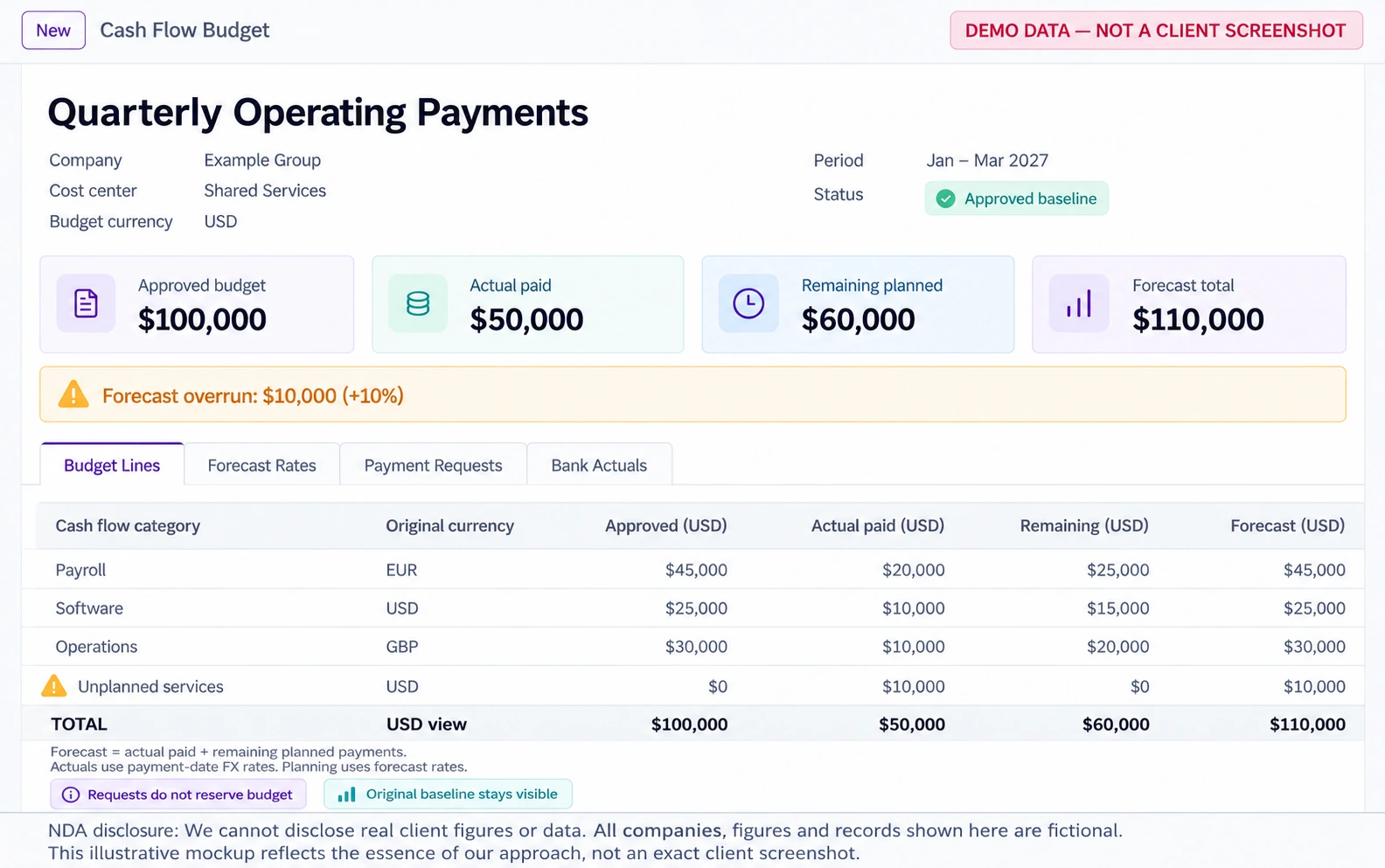
In the example below, the approved payment budget is $100,000. Of its planned payments, $40,000 has been paid and $60,000 remains. Another $10,000 has already been paid outside the original plan.
| Measure | USD | Explanation |
|---|---|---|
| Approved budget | $100,000 | The authorized baseline. |
| Planned payments already made | $40,000 | Paid against the original plan. |
| Unplanned payments already made | $10,000 | Paid outside the original plan. |
| Total actual payments | $50,000 | $40,000 + $10,000. |
| Remaining planned payments | $60,000 | Original planned payments still expected. |
| Forecast total payments | $110,000 | $50,000 actual + $60,000 remaining. |
| Forecast overspend | $10,000 | $110,000 forecast − $100,000 approved. |
Forecast total payments = total actual payments + remaining planned payments. The total actual already includes paid unplanned amounts; do not add them a second time. In this example, an overspend is expressed as a positive excess of forecast payments over the approved payment budget.
The $110,000 forecast does not automatically become a newly approved budget. The approved amount remains $100,000 unless a separate revision is authorized. This calculation covers paid actuals and remaining planned payments; treatment of approved but unpaid unplanned requests must be agreed in the implementation.
Bank reconciliation matches bank activity with accounting records. Budget allocation identifies which plan a cash movement executes. Automatic totals depend on correct allocation; they are not a promise that every transaction identifies its own budget.
Approve payment requests using category-specific workflows
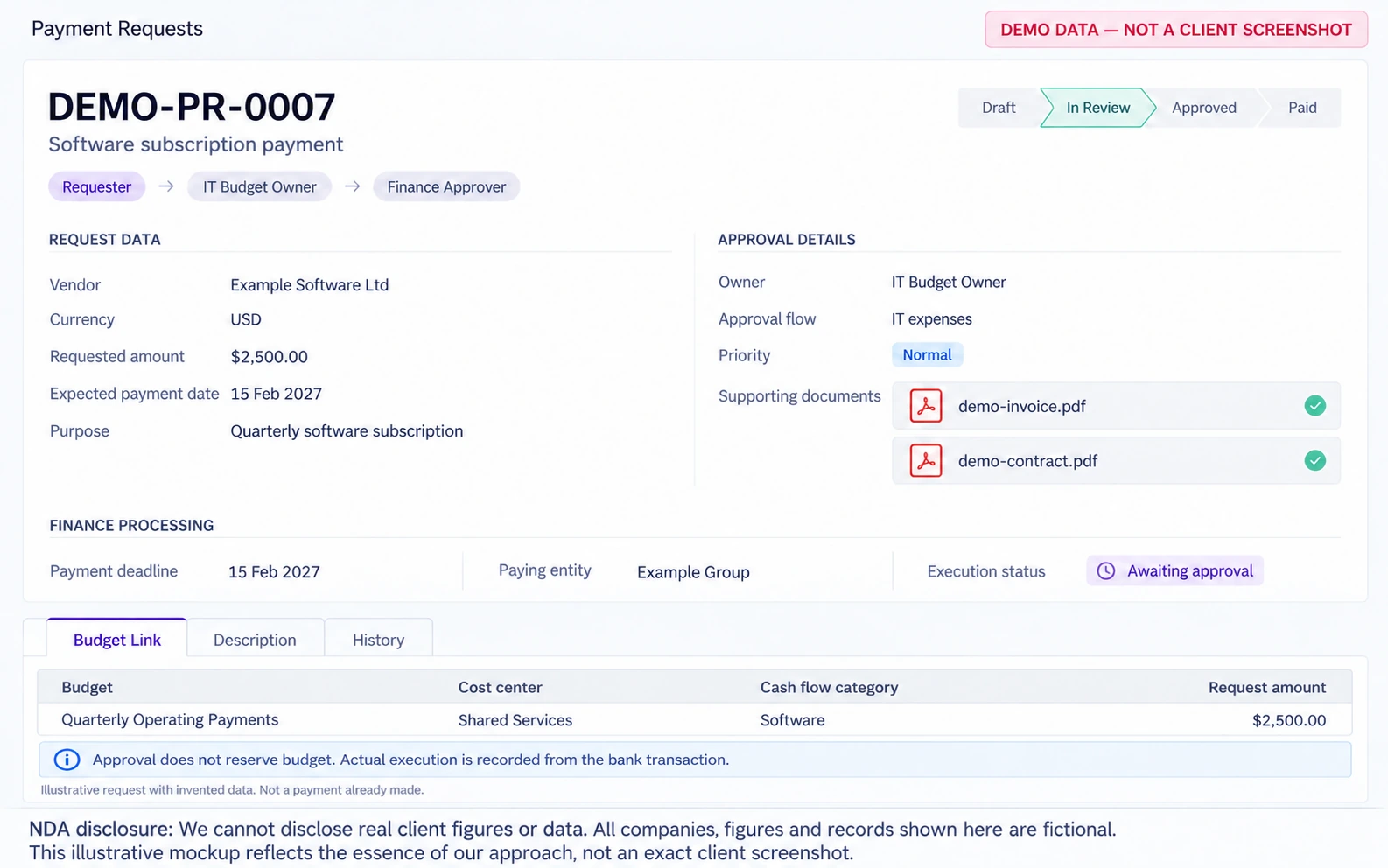
A payment request identifies the supplier, supporting invoice, amount, currency, and relevant budget. The company can configure different approval templates for marketing, IT, payroll, or other payment categories.
Request → category-specific review → approval → execution by finance → bank reconciliation and budget allocation.
In the described workflow, an approved request does not reserve budget. Its approval authorizes the request for the next stage; it does not establish that money has left the bank. Actual execution remains linked to the bank transaction.
Budget approval, request approval, and bank execution are separate events. Do not infer automatic blocking of an over-budget request from the existence of an approval route. See treasury management for the wider liquidity and payment-control context.
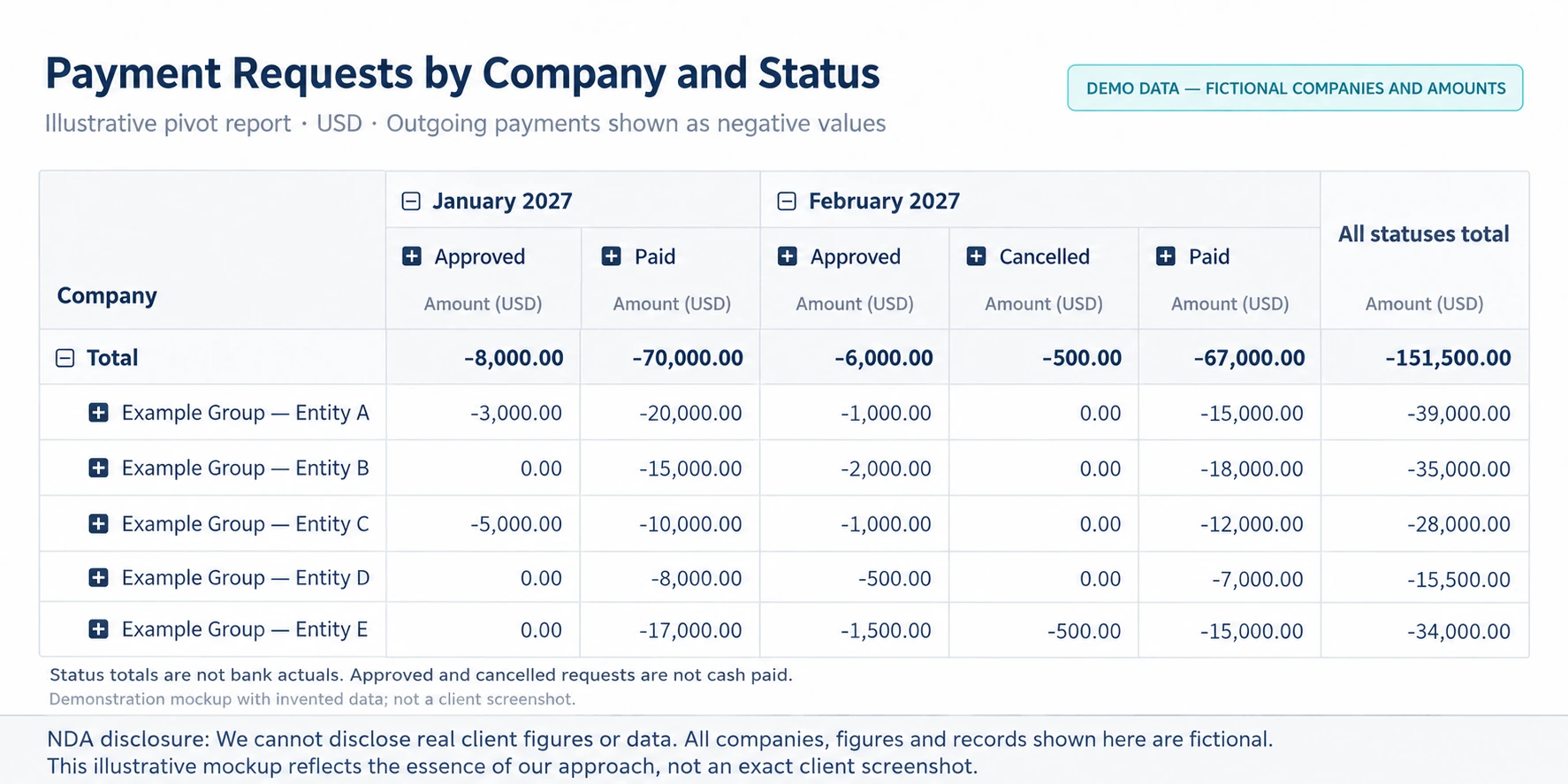
Review payment requests by company and status
The illustrative pivot below groups requests by company, month and status. Review Paid separately from Approved and Cancelled: summing all request statuses does not establish cash paid. Actual execution must still be checked against bank transactions.
Keep overruns visible, even when budgets can be revised
In my view, a budget overrun is important management information. Approving a revised budget should not make the original deviation disappear.
We support approval of revised budget versions. However, a business often needs to see that execution has exceeded its original agreement. Replacing the baseline with a higher amount can make the latest comparison look acceptable while obscuring what changed.
Review the original approved plan alongside any authorized revision, actual payments, and current forecast. Investigate whether a variance reflects timing, additional scope, supplier pricing, currency effects, or an incomplete original plan. These are questions for analysis, not a claim that the system automatically determines every cause.
Over time, this history helps finance identify cash flow categories that repeatedly exceed their plans and adapt financial policy for the next quarter.
Use direct-method reporting to understand where cash went
A cash flow forecast looks ahead. A cash flow statement explains recorded cash movements. In our direct-method reporting approach, bank movements are classified into cash flow categories so finance can inspect actual receipts and payments.
The direct method presents major categories of cash receipts and payments. The indirect method derives operating cash flow by adjusting profit for non-cash items and other differences. See the IAS 7 overview.
Our Direct Method Cash Flow guide explains ERPixel’s reporting solution. Category rules need to treat internal transfers appropriately so movements between a company’s own accounts do not inflate external receipts and payments.
What belongs in standard Odoo and what needs a defined project scope?
Standard Odoo includes accounting reports and budgets. Odoo 19 documentation lists a Cash Flow Statement, aged receivables and payables, and analytic and financial budgets. These provide accounting tools alongside the specific treasury-planning workflow described here. See the official reporting and budget documentation.
| Need | What to assess |
|---|---|
| Accounting and historical reporting | Standard reports, account configuration, and reconciliation in the relevant Odoo version. |
| Cost-center cash planning | Dated gross payments, budget ownership, forecast currencies, and approval requirements. |
| Payment authorization | Request documents and category-specific approval templates. |
| Execution and forecast | Bank-to-budget allocation, historical payment rates, remaining planned payments, and visible overruns. |
ERPixel Cash Flow Budgeting is confirmed for Odoo 18 Enterprise and Odoo 19 Enterprise. Confirm the versions, dependencies, and configuration of related treasury and direct-method reporting modules in the proposal. Custom-module installation also needs an appropriate deployment environment: standard Odoo Online does not support custom modules. See Odoo Online documentation and our Odoo hosting comparison.
A practical review routine for finance teams
| Review | Suggested owner | Expected output |
|---|---|---|
| Prepare the next quarter | Cost-center owners and finance | Reviewed recurring budgets, one-off items, payment dates, and currency assumptions. |
| Approve the plan | Authorized budget approvers | A clear approved baseline and responsibilities. |
| Review near-term liquidity | Finance or treasury | Expected receipts, due payments, cash availability, and actions for gaps. |
| Process bank actuals | Finance | Reconciled transactions correctly allocated to budgets and cash flow categories. |
| Investigate deviations | Finance and cost-center owners | Explained changes and an updated expectation of remaining payments. |
| Improve the next cycle | Finance leadership | Revised assumptions and policy based on recurring variance patterns. |
My recommendation is to start with the decisions and responsibilities, then configure the software around them. Automation is most useful when it keeps the approved plan, actual execution, and current forecast connected.
If your group relies on linked spreadsheets or struggles to connect budgets with payments, Odoo consulting can establish the workflow and scope. Odoo implementation then puts the agreed process into operation, with Odoo Accounting as part of the financial context.
Discuss your cash flow budgeting and treasury workflow with me. We can review your company structure, planning currencies, approvals, and bank-to-budget process before defining the implementation.