
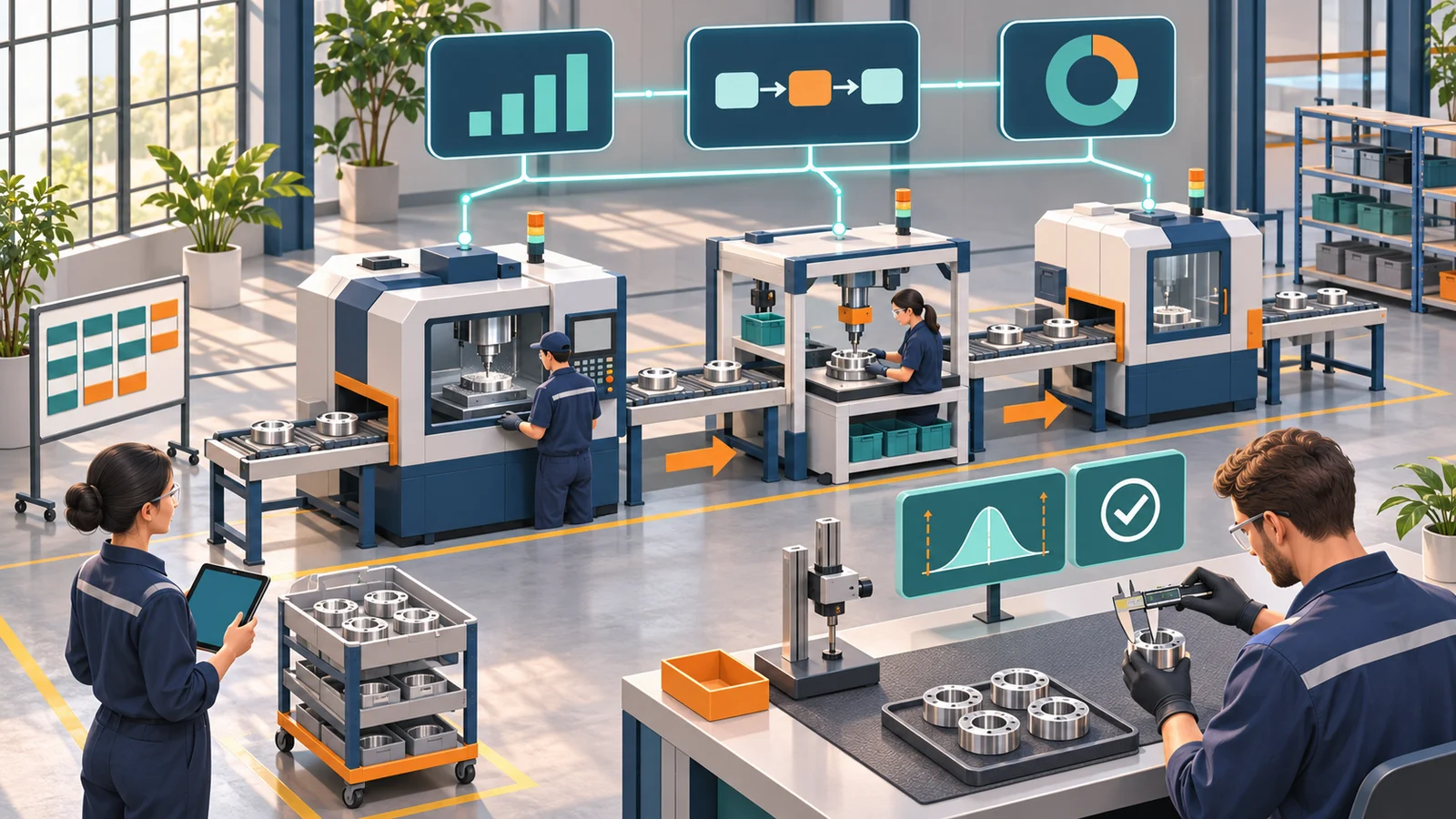
Lean manufacturing improves how work flows and removes waste. Six Sigma reduces unwanted variation and defects. They work well together: a process should move smoothly and produce a consistent result. ERP software such as Odoo can connect the records behind that process, but installing it does not create a Lean culture or complete a Six Sigma programme.
This guide is for manufacturing owners, production managers and quality teams who need fewer queues, clearer material requirements and reliable quality records. The practical question is where to improve the process first, and where software can help sustain that improvement.
Lean manufacturing vs Six Sigma: what is the difference?
Lean developed from practices associated with the Toyota Production System; Six Sigma emerged at Motorola. Neither is a recent software trend. Their purpose remains relevant when production data moves from paper to connected systems.
| Approach | Main question | Typical methods | Manufacturing example |
|---|---|---|---|
| Lean | Where does work wait or consume resources without creating customer value? | Value-stream mapping, standardised work, pull replenishment, Kaizen | Reduce queues between cutting and assembly. |
| Six Sigma | Why does the output vary, and what causes defects? | DMAIC, measurement analysis, control charts, experiments | Investigate inconsistent dimensions from a machining operation. |
| Lean Six Sigma | How can we improve flow and consistency together? | A combination selected for the actual problem | Shorten the queue while checking that faster processing does not increase defects. |
ASQ explains the distinction: Lean emphasises waste and flow; Six Sigma emphasises variation and process control. A quality inspection finds a problem. Improvement also requires understanding and changing what caused it.
Core terms: flow, quality and observation
Some terms describe a management principle; others describe a particular tool. Keeping them separate prevents a software feature from being mistaken for the whole method.
| Term | Practical meaning | Important distinction |
|---|---|---|
| Muda | Waste: effort or resources that do not create customer value. | Look for overproduction, waiting, unnecessary transport or motion, excess inventory, overprocessing and defects. Unused human capability is often added as an eighth category. |
| Kaizen | Continuous improvement involving the people doing the work. | A task board can track actions; improvement still needs observation and follow-through. |
| Kanban | A signal authorising production or replenishment in a pull system. | An Odoo Kanban view displays records as cards. That alone does not establish pull control. |
| Standardised work | A defined work sequence, related to customer demand and the required in-process stock. | Seiketsu belongs to 5S workplace organisation; it is not a synonym for standardised work. |
| Genchi Genbutsu | Go and see the actual conditions at the source. | Observation supports root-cause analysis; it does not replace it. |
| Takt time | Available production time divided by customer demand for the same period. | Cycle time is the time to carry out a cycle; lead time measures elapsed time through the defined process. |
| Just-in-time | Provide what is needed, when needed, in the needed quantity. | It does not mean removing every buffer regardless of supplier reliability or demand variation. |
| Backflushing | Record component consumption from reported output and predefined quantities. | This is an inventory recording method. Actual usage and scrap still need control. |
The Lean Enterprise Institute describes standardised work, 5S and Seiketsu, and Genchi Genbutsu separately. These distinctions matter when writing procedures and training operators.
Why improvements get lost between departments
A workshop may look organised while purchasing keeps ordering components for an outdated forecast. A quality team may identify a defect while the next shift continues using the same instructions. Sales may change an order without the planner seeing it in time.
These are information and responsibility gaps. ERP can help by connecting demand, stock, purchasing, production and delivery. Lean and Six Sigma can also be practised without ERP; the value of an integrated system is maintaining shared records as transactions and handovers become harder to coordinate.
The desired result is straightforward: the planner sees material requirements, the operator follows the current instructions, quality results remain linked to the operation, and the responsible person reviews exceptions. The physical process and the system records should agree.
A practical example: a queue and a recurring defect
Illustrative example, not an ERPixel client case. An assembly team waits for machined parts. Some arriving parts also need rework because a dimension falls outside the agreed tolerance.
A Lean investigation follows the work from machining to assembly: batch size, queues, transfers and priorities. A Six Sigma investigation examines the dimension: how it is measured, whether the measurement is reliable, and which process conditions explain the variation. Increasing machining output alone could enlarge the queue and produce more defective parts.
Odoo can hold production records and configured quality checks. The team still needs to observe the operation, test causes and decide whether the remedy is a tooling change, a different work sequence, training or another process adjustment.
Use DMAIC to turn a complaint into a controlled improvement
DMAIC means Define, Measure, Analyse, Improve and Control. It gives a recurring quality problem a clear working sequence:
- Define: agree on the customer requirement and the problem boundary. For the example above, name the product, operation and dimension rather than starting with “quality is poor”.
- Measure: collect a baseline using a consistent method. Record measured values, quantities, time periods and relevant production conditions; check the measurement system before trusting comparisons.
- Analyse: examine potential causes using shop-floor observation and appropriate analysis. A relationship in a dashboard is a lead to investigate, not proof of a cause.
- Improve: test a specific change on a manageable scope. Check both quality and flow so an improvement in one area does not hide a new problem elsewhere.
- Control: update instructions, assign an owner and define the response when the process drifts. Review results over time instead of closing the task after one good batch.
Odoo supports the operational records around these steps. Specialist measurement-system studies, designed experiments and statistical process control may require additional tools and expertise.
How it works in Odoo
The following examples refer to Odoo 19.0 documentation. App availability depends on edition and installed modules; check the proposed scope against your database. These are standard application capabilities and configuration choices, not a separate ERPixel Lean or Six Sigma product.
Connect manufacturing records before adding automation
Start with accurate products, bills of materials, operations, work centres and lead times. A planner checks requirements and an operator records production against the relevant order. Our Odoo Manufacturing guide explains the material-to-finished-product flow; the production scheduling guide covers planning in more detail.
Choose replenishment rules that match the demand
Forecast planning and pull replenishment serve different needs. Odoo’s Master Production Schedule (MPS) supports planning from an adjustable forecast and uses manual replenishment. It is not automatically a Kanban pull system. The documentation advises against applying reordering rules to the same products managed through MPS.
Put quality checks at meaningful points
With the Quality app, configure quality control points for selected products and operations. In the machining example, a measurement check can prompt the operator to record the dimension at the relevant stage. Decide who reviews a failed check and how affected material is handled. Recording a measurement does not by itself establish statistical process control or prove process capability.
Plan maintenance and follow up on improvements
Odoo Maintenance supports corrective and preventive maintenance. Predictive maintenance based on sensor data needs a separately verified data and integration design. Improvement actions can be assigned and followed in Project; operators also need clear instructions and manufacturing training so records reflect the work actually done.
Measure improvement without promising a growth multiple
Agree on definitions and compare similar products, shifts and demand conditions. A useful starting set is:
- Lead time: elapsed time between agreed start and finish points, including waiting.
- Work in progress (WIP): unfinished production inside that process.
- First-pass yield: units passing the defined process without rework divided by units entering it.
- Scrap and rework: recorded separately, with consistent quantities, costs and reasons.
- On-time delivery: deliveries meeting the agreed commitment, using a stable definition of “on time”.
A lower inventory balance is not an improvement if shortages increase. Higher machine utilisation is not enough if queues grow. Review the measures together. If your analysis needs data from several systems, business intelligence services can help organise reporting; the operational definitions come first.
Where to start with ERPixel
Choose one product family and one recurring problem. Map the actual work, check the quality of the records and agree on a baseline before changing the system. ERPixel’s manufacturing services and Odoo implementation work cover the software and process setup around production.
Bring a sample order, your production steps and the problem you want to measure. Book a meeting with Alexander Koltsov to discuss which standard features, configuration, training or integration work your process needs.