
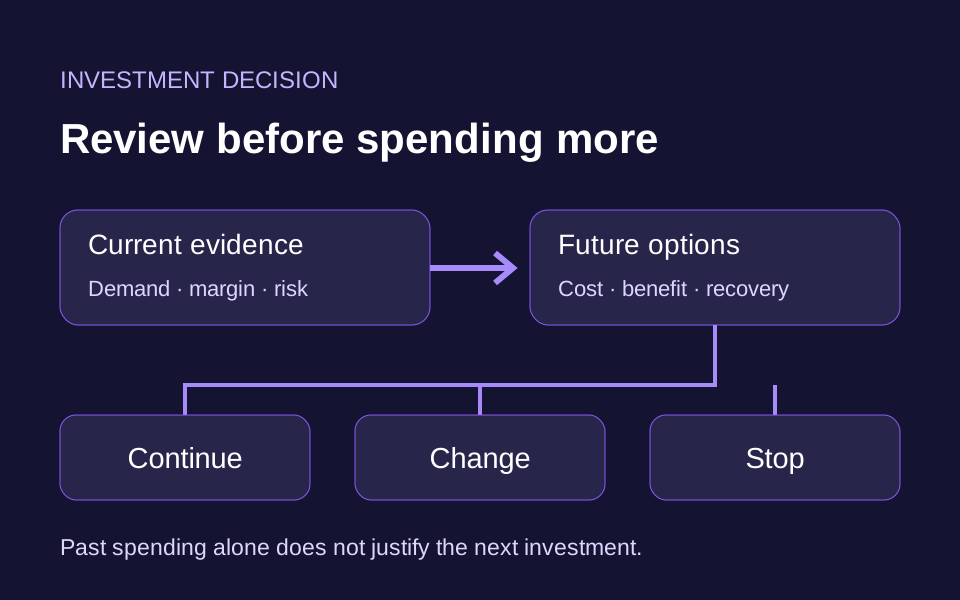
An interview about unrecoverable costs, investment decisions, and keeping business projects under control.
What does “sunk cost” mean, and why should entrepreneurs care?
A sunk cost is a cost already incurred that cannot be recovered and will not change whichever option you choose next. The sunk cost fallacy means continuing an activity because of those past costs, rather than because its expected future benefits justify its future costs.
Imagine you pay €10,000 for market research before launching a product. The research is completed, but it reveals weak demand. You cannot recover the fee. You now face a different decision: should you invest another €50,000 in the launch?
The original €10,000 will remain spent whether you launch or stop. Your decision should therefore focus on what the next €50,000 could achieve, the risks involved, and the alternatives available. This matters because the desire to justify earlier spending can turn a manageable loss into a much larger one.
Businesses spend money before getting results. Does that make every early investment a sunk cost?
No. Spending before earning revenue is a normal part of business. The important question is whether the expenditure can still be recovered.
A refundable supplier deposit can be returned. Unsold inventory may be sold or used elsewhere. Equipment may have resale value. Payment for a completed research study is usually unrecoverable, but discovering weak demand before launch could save you from a much larger loss.
A sunk cost is not necessarily a wasted cost. It may have purchased useful knowledge, even though the money cannot be recovered.
Does buying equipment, materials, or services make the entire investment unrecoverable?
Not automatically. Suppose you bought equipment for €30,000 and could now sell it for €20,000. You should not treat the entire €30,000 as money that has disappeared without any remaining value. Keeping the equipment means giving up the opportunity to sell it for €20,000.
A completed prototype may also be reusable in another product, even if the development fee cannot be refunded. The historical payment cannot be undone, but the current value of equipment, inventory, software, or knowledge still belongs in your decision.
For inventory, distinguish its accounting cost from the amount you could recover by selling it. Our guide to landed costs in Odoo explains how additional acquisition costs become part of inventory value; that value is not a guarantee of resale proceeds.
Is sunk cost a separate accounting category?
Usually, no. It is primarily a concept used in managerial decision-making. If a completed research service has already been recorded as an expense through a vendor bill, you do not need another entry simply to label it a sunk cost. Equipment may remain recorded as an asset under the applicable accounting rules.
Accounting records what happened to the company’s resources. Sunk-cost analysis helps answer a different question: “What should we do next?” Our guide to vendor bills, stock valuation, and purchase order matching explains the underlying accounting workflow.
How do sunk costs compare to other managerial accounting cost types?
The distinction is about how a cost affects the next decision. Consider a manufacturer deciding whether to accept a custom production order:
| Cost type | Meaning | Relevant to the next decision? | Business example |
|---|---|---|---|
| Sunk Cost | A cost already incurred that cannot be recovered. | No: it remains unchanged across the alternatives. | €8,000 paid for a completed, non-refundable tooling feasibility study, whether the order is accepted or rejected. |
| Relevant Cost | A future cost that differs between alternatives. | Yes. | €6,000 for additional components needed only if the custom order is accepted. |
| Opportunity Cost | The benefit forgone by choosing one alternative over another. | Yes. | €4,000 in contribution margin forgone from another order because both require the same limited machine capacity. |
| Fixed Cost | A cost that does not vary with activity within a defined range and period. | Only if it differs between alternatives. | A €1,200 monthly equipment lease payable whether this order is accepted or rejected is irrelevant to that comparison. For a shutdown decision, future lease payments matter if termination avoids them. |
These are not mutually exclusive categories. A fixed cost can also be relevant when a decision changes it. Opportunity cost is a forgone benefit, not necessarily an accounting expense. The figures above are illustrative.
How are sunk costs different from deferred expenses?
Deferred expenses concern when a cost is recognized as an expense. Sunk costs concern whether an incurred cost can be recovered when you change course.
A company prepays €12,000 for an annual software subscription. If the cost is recognized monthly, €1,000 becomes an expense after the first month, while €11,000 remains prepaid. If the contract does not allow a refund, the payment is unrecoverable when considering a switch to another system. However, the right to use the existing subscription still has value.
The same expenditure can therefore be prepaid in accounting and sunk for a particular decision.
What is the sunk cost fallacy in a business project?
Suppose an entrepreneur has invested €100,000 in a new product. Initial sales are disappointing, and the next stage requires another €30,000. Continuing may be sensible if new evidence identifies a promising customer segment or a credible way to improve the economics.
But “We have already spent €100,000, so we cannot stop now” is not a sufficient reason. Continuing is not automatically a mistake. Continuing to justify past spending is the mistake.
The same distinction matters in ERP projects. Our article on measuring ERP implementation ROI provides related context for evaluating business value.
Is this like a poker player saying, “I have put money into the pot, so I will keep calling”?
Yes. A player has already contributed €100 to the pot. An opponent bets, and the player must pay another €50 to continue. The player thinks: “I cannot give up my €100.” But those chips are already in the pot. The current decision concerns the additional €50.
Assume there is €200 in the pot before the player calls. Calling €50 would make the final pot €250. In a simplified situation with no further betting and no rake, the expected incremental result is winning probability × €250 − €50. The player needs a winning probability above 20% for the call to have positive expected value.
If the chance of winning is only 10%, the expected result of calling is €25 − €50 = −€25. The desire to recover the previous €100 does not make calling worthwhile.
Previous bets still matter: they determine the pot size and provide information about opponents. What should not drive the decision is emotional attachment to the money already committed. The business equivalent is approving another investment because you cannot bear to abandon the earlier one.
How can an entrepreneur recognize the problem during a product launch?
Separate what has already happened from the next decision. Consider a company buying inventory, renting an office, paying employees, and advertising a new product. Completed work and advertising already delivered are generally unrecoverable. Inventory may retain resale value. Some future spending can be cancelled; other commitments may require termination payments.
Before approving the next budget, ask: “Given today’s product, assets, team, and evidence, would I approve this investment without trying to justify our previous spending?”
- Are targets repeatedly postponed without new supporting evidence?
- Is more funding requested without explaining what it will change?
- Is discussion of closure treated as disloyalty or failure?
- Is the amount already invested the main argument for continuing?
Missing a target does not, by itself, prove the fallacy is present. The question is whether the next decision has a credible justification.
What management approach helps prevent the sunk cost fallacy?
Divide the project into stages and make a fresh funding decision between them. This is the principle behind Stage-Gate. Before each stage, define the assumption to test, the budget and time available, the evidence expected, and the conditions for continuing, changing direction, pausing, or stopping.
For example, allocate €15,000 and two months to test demand. Your objectives are to acquire 20 paying customers and demonstrate a positive contribution margin per sale. These are illustrative targets, not universal benchmarks.
At the review, you have five customers and each sale loses money. The next budget should not be approved automatically. Perhaps the test revealed demand from a different customer group. A smaller, targeted experiment could be justified. If there is no credible new hypothesis, pausing or stopping may be better.
Reviews use both metrics and judgment. They are not automatic shutdown rules: their purpose is to make the next investment depend on evidence. See the Stage-Gate overview.
Is this mainly useful when managing several products at once?
It works for a single project, but becomes particularly useful across a portfolio. Stage-Gate asks: “Does this project deserve funding for its next stage?” Portfolio management asks: “Which projects should receive our limited money and people?”
Three projects may each look promising, while the company can afford only two. Management must compare expected returns, risks, timing, and strategic importance. An older project should not receive priority merely because more money has already been spent on it. Equally, a new project is not automatically better.
Can investment control be organized in Odoo ERP?
Yes. In our Odoo ERP implementation practice, we can organize investments as projects, link each project to an analytic account, and track associated costs. Our Analytic Accounting glossary entry explains accounts, plans, and cost distribution.
During planning, we can distinguish between expenditure expected to become unrecoverable once incurred and investments whose value could be partly recovered if the project stops early. Consider a €100,000 launch budget:
| Planned investment | Amount | Estimated recovery if the project stops |
|---|---|---|
| Completed market research and advertising tests | €20,000 | €0 |
| Equipment | €50,000 | €35,000 through resale |
| Inventory | €30,000 | €20,000 through clearance sales |
| Total | €100,000 | €55,000 |
These are planning estimates. Actual recovery depends on market prices, timing, selling costs, and contractual conditions. Future expenditure is not yet a sunk cost: this classification anticipates what could become unrecoverable after the money is committed.
Odoo’s analytic accounting supports tracking costs and revenues against analytic accounts and plans. See the official Odoo documentation.
With the appropriate configuration, we can compare planned budgets with actual costs, identify recognized costs and their supporting documents, and monitor commitments and forecast remaining expenditure. Our guide to accrual budgets in Odoo explains budgeting in more detail.
For us as automation specialists and Odoo partners, this is a practical implementation task. The configuration depends on the Odoo version, installed modules, and the company’s accounting and reporting requirements. This work can form part of Odoo implementation, with business intelligence reporting where consolidated management views are needed.
How does this help entrepreneurs avoid the fallacy?
It replaces “We have already spent €60,000” with a more useful picture: which costs are unrecoverable, which assets retain value, which payments are committed, how much additional funding is required, and what results the expenditure has produced.
However, spending 60% of the budget does not mean the project is 60% complete or commercially viable. Budget consumption must be assessed alongside demand, sales, margins, and delivery progress.
Odoo provides financial visibility. The management process determines how that information guides investment decisions.
How should a business respond if it is already caught in the sunk cost fallacy?
First, stop automatic budget increases. Compare continuation, redesign, a pause, and closure. For each option, assess future cash flows, risks, and consequences. Stopping may involve contract penalties, customer obligations, and closure costs. Selling equipment or inventory may recover part of the investment.
Past unrecoverable spending should not determine the choice. Recoverable assets and future consequences should. This distinction is reflected in investment-appraisal guidance such as the Green Book.
An independent reviewer can challenge assumptions without having to defend the original decision. If continuation remains justified, approve a limited next stage with clear objectives. Otherwise, close the project and preserve useful assets and knowledge.
What is your main advice before an entrepreneur invests?
Decide in advance how much loss the business can absorb, when the project will be reviewed, and what would justify another investment. Prepare an exit plan before you need one.
A management process cannot remove emotion, but it can prevent emotion from becoming the only reason to continue. It can also help correct course when the fallacy has already started influencing decisions.
Every new investment should earn its justification through expected future value—not through the size of past spending.